Custom Backyard Putting Greens in Sacramento, Bay Area & Lake Tahoe
40+ years of putting green installation experience. Premium AGL Grass North Golf Leisure turf with true ball roll, custom contouring, and championship green speeds. It’s time to perfect your golf game!


Why Build a Backyard Putting Green?
If you’re a serious golfer in Northern California, you’ve probably done the math. A round at Whitney Oaks, Empire Ranch, Serrano, or Silverado runs you a few hundred bucks plus four hours plus a 30-minute drive each way. A backyard putting green pays for itself in the first year, and unlike the range, you can practice the part of your game that actually moves your handicap.
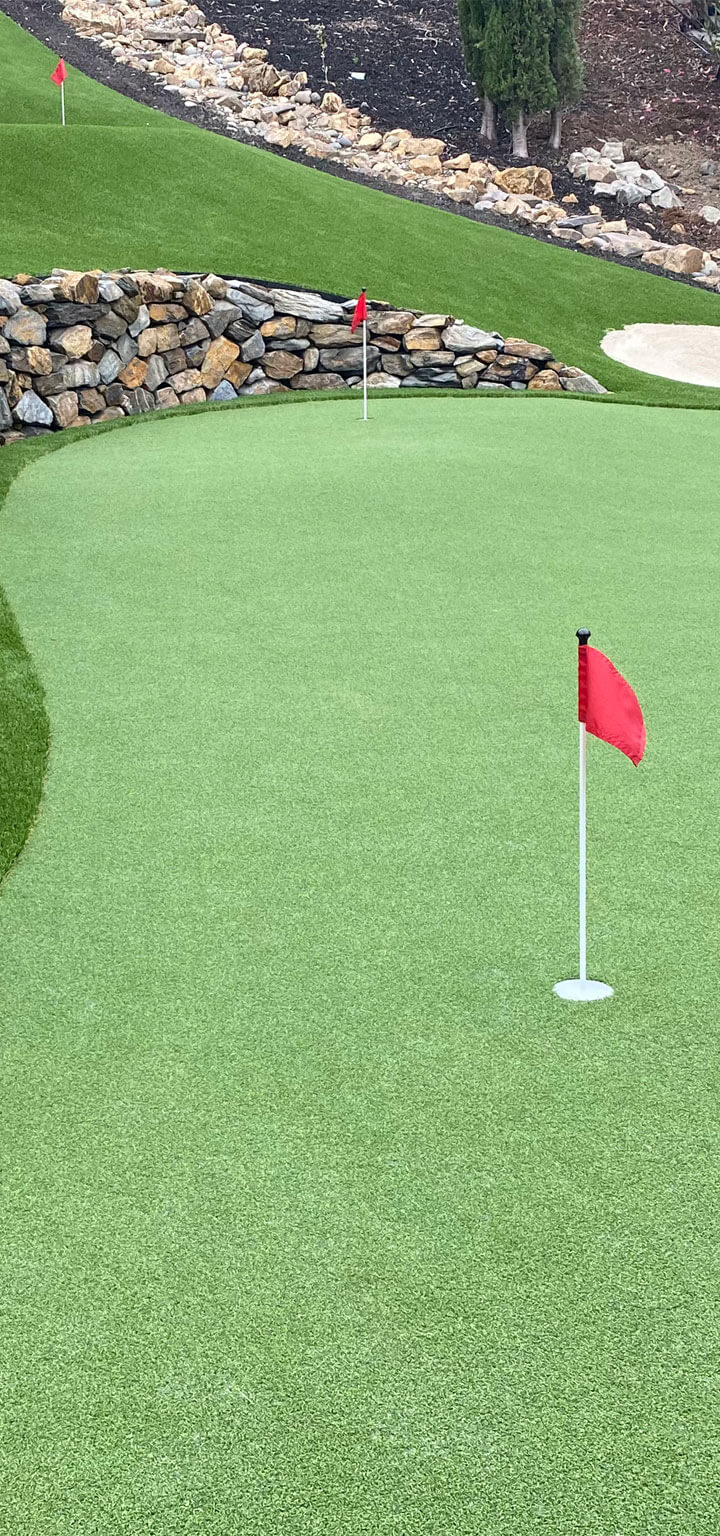
We’ve been building backyard putting greens for over 40+ years. Mini golf courses, short-game practice areas, two-cup chipping greens, full 1,500-square-foot installations with sand traps and contoured breaks. Our crews have done it all, and the AGL Grass North putting green products we install are the same nylon-fiber turf used at high-end practice facilities and country club short-game areas across the country.
If you’ve ever putted on a backyard “putting green” that rolled like shag carpet and wondered if there was any point, then yes, there is. A real putting green built right, with the right turf, the right base, and proper contouring, plays at championship speeds. We’ll show you the difference at your free backyard putting green consultation.
Why Build a Backyard Putting Green?
If you’re a serious golfer in Northern California, you’ve probably done the math. A round at Whitney Oaks, Empire Ranch, Serrano, or Silverado runs you a few hundred bucks plus four hours plus a 30-minute drive each way. A backyard putting green pays for itself in the first year, and unlike the range, you can practice the part of your game that actually moves your handicap.
We’ve been building backyard putting greens for over 40+ years. Mini golf courses, short-game practice areas, two-cup chipping greens, full 1,500-square-foot installations with sand traps and contoured breaks. Our crews have done it all, and the AGL Grass North putting green products we install are the same nylon-fiber turf used at high-end practice facilities and country club short-game areas across the country.
If you’ve ever putted on a backyard “putting green” that rolled like shag carpet and wondered if there was any point, then yes, there is. A real putting green built right, with the right turf, the right base, and proper contouring, plays at championship speeds. We’ll show you the difference at your free backyard putting green consultation.
Why Build a Backyard Putting Green?
If you’re a serious golfer in Northern California, you’ve probably done the math. A round at Whitney Oaks, Empire Ranch, Serrano, or Silverado runs you a few hundred bucks plus four hours plus a 30-minute drive each way. A backyard putting green pays for itself in the first year, and unlike the range, you can practice the part of your game that actually moves your handicap.
We’ve been building backyard putting greens for over 40+ years. Mini golf courses, short-game practice areas, two-cup chipping greens, full 1,500-square-foot installations with sand traps and contoured breaks. Our crews have done it all, and the AGL Grass North putting green products we install are the same nylon-fiber turf used at high-end practice facilities and country club short-game areas across the country.
If you’ve ever putted on a backyard “putting green” that rolled like shag carpet and wondered if there was any point, then yes, there is. A real putting green built right, with the right turf, the right base, and proper contouring, plays at championship speeds. We’ll show you the difference at your free backyard putting green consultation.
What Can a Real Putting Green Do?
A properly installed backyard putting green built with AGL Grass North Golf Leisure nylon turf can be set to stimp speeds of 9–11, comparable to a well-maintained country club green. Premium nylon putting green turf provides true ball roll with no grain bias, holds approach shots with appropriate spin response, and lasts 15–20 years with proper installation. A real backyard green lets you practice every shot you actually face on course: short putts, lag putts, breaking putts, and with Kent Fringe Grass, full approach shots from 5–30 yards.
What Can a Real Putting Green Do?
A properly installed backyard putting green built with AGL Grass North Golf Leisure nylon turf can be set to stimp speeds of 9–11, comparable to a well-maintained country club green. Premium nylon putting green turf provides true ball roll with no grain bias, holds approach shots with appropriate spin response, and lasts 15–20 years with proper installation. A real backyard green lets you practice every shot you actually face on course: short putts, lag putts, breaking putts, and with Kent Fringe Grass, full approach shots from 5–30 yards.
What Can a Real Putting Green Do?
A properly installed backyard putting green built with AGL Grass North Golf Leisure nylon turf can be set to stimp speeds of 9–11, comparable to a well-maintained country club green. Premium nylon putting green turf provides true ball roll with no grain bias, holds approach shots with appropriate spin response, and lasts 15–20 years with proper installation. A real backyard green lets you practice every shot you actually face on course: short putts, lag putts, breaking putts, and with Kent Fringe Grass, full approach shots from 5–30 yards.
What Makes a Real Putting Green
A backyard putting green is only as good as four things: the turf, the base, the contour, and the installation. Get any one of them wrong and you’ve got an expensive piece of green carpet that doesn’t roll right. Here’s what separates a real putting green from a knockoff:

Turf Material
Real putting greens use nylon fiber, not polyethylene. Nylon stands up under sand infill, doesn’t mat down under repeated foot traffic, and produces consistent ball roll across the entire surface. Cheap “putting greens” use polyethylene (the same material as residential lawn turf), which mats, develops grain, and can’t handle real practice volume.
Sand Infill
A real green uses kiln-dried silica sand worked into the turf to give the surface its weight, speed, and ball-stopping power. The amount and depth of infill determines stimp speed. More infill = slower green, less infill = faster green. AGL Grass is a no-infill artificial turf, but that doesn’t mean you can’t customize the green speed by adding your own infill.
Contoured Base
Flat greens are practice greens for putting fundamentals, but most clients want at least some contour: a back-to-front slope, side breaks, maybe a small undulation in the middle for shaping breaking putts. We build the contour into the compacted base, then lay the turf over it. Done right, the breaks are subtle and natural; not bumps or hills.
Chipping Fringe
A two-product green uses AGL Grass North Golf Leisure for the putting surface and Kent Fringe Grass for the surrounding chipping area. The Kent fringe is taller, holds the ball, and lets you practice realistic approach shots from short range. Without a fringe, the green is just a putting surface, which is fun, but limited.
Proper Base Prep
Like any artificial turf installation, the base is what determines whether the green stays flat, drains properly, and lasts decades. We use the same compacted Class II road base we use under residential lawn turf, with extra attention to grading for the desired contour.
What Makes a Real Putting Green
A backyard putting green is only as good as four things: the turf, the base, the contour, and the installation. Get any one of them wrong and you've got an expensive piece of green carpet that doesn't roll right. Here's what separates a real putting green from a knockoff:
Turf Material
Real putting greens use nylon fiber, not polyethylene. Nylon stands up under sand infill, doesn’t mat down under repeated foot traffic, and produces consistent ball roll across the entire surface. Cheap “putting greens” use polyethylene (the same material as residential lawn turf), which mats, develops grain, and can’t handle real practice volume.
Sand Infill
A real green uses kiln-dried silica sand worked into the turf to give the surface its weight, speed, and ball-stopping power. The amount and depth of infill determines stimp speed. More infill = slower green, less infill = faster green. AGL Grass is a no-infill artificial turf, but that doesn’t mean you can’t customize the green speed by adding your own infill.
Contoured Base
Flat greens are practice greens for putting fundamentals, but most clients want at least some contour: a back-to-front slope, side breaks, maybe a small undulation in the middle for shaping breaking putts. We build the contour into the compacted base, then lay the turf over it. Done right, the breaks are subtle and natural; not bumps or hills.
Chipping Fringe
A two-product green uses AGL Grass North Golf Leisure for the putting surface and Kent Fringe Grass for the surrounding chipping area. The Kent fringe is taller, holds the ball, and lets you practice realistic approach shots from short range. Without a fringe, the green is just a putting surface, which is fun, but limited.
Proper Base Prep
Like any artificial turf installation, the base is what determines whether the green stays flat, drains properly, and lasts decades. We use the same compacted Class II road base we use under residential lawn turf, with extra attention to grading for the desired contour.
What Makes a Real Putting Green
A backyard putting green is only as good as four things: the turf, the base, the contour, and the installation. Get any one of them wrong and you've got an expensive piece of green carpet that doesn't roll right. Here's what separates a real putting green from a knockoff:
Turf Material
Real putting greens use nylon fiber, not polyethylene. Nylon stands up under sand infill, doesn’t mat down under repeated foot traffic, and produces consistent ball roll across the entire surface. Cheap “putting greens” use polyethylene (the same material as residential lawn turf), which mats, develops grain, and can’t handle real practice volume.
Sand Infill
A real green uses kiln-dried silica sand worked into the turf to give the surface its weight, speed, and ball-stopping power. The amount and depth of infill determines stimp speed. More infill = slower green, less infill = faster green. AGL Grass is a no-infill artificial turf, but that doesn’t mean you can’t customize the green speed by adding your own infill.
Contoured Base
Flat greens are practice greens for putting fundamentals, but most clients want at least some contour: a back-to-front slope, side breaks, maybe a small undulation in the middle for shaping breaking putts. We build the contour into the compacted base, then lay the turf over it. Done right, the breaks are subtle and natural; not bumps or hills.
Chipping Fringe
A two-product green uses AGL Grass North Golf Leisure for the putting surface and Kent Fringe Grass for the surrounding chipping area. The Kent fringe is taller, holds the ball, and lets you practice realistic approach shots from short range. Without a fringe, the green is just a putting surface, which is fun, but limited.
Proper Base Prep
Like any artificial turf installation, the base is what determines whether the green stays flat, drains properly, and lasts decades. We use the same compacted Class II road base we use under residential lawn turf, with extra attention to grading for the desired contour.
AGL Grass North Putting Green Products
We install two AGL Grass North products on every full putting green installation:
Golf Leisure is the putting surface product:
Nylon construction for durability under repeated foot traffic and infill weight
Short, dense pile (½-inch nominal) for true ball roll
Sand infill construction with adjustable depth for tunable stimp speed
Contour-friendly turf that drapes cleanly over crowns, breaks, and slopes without wrinkling
15-year residential warranty, 8-year commercial
REACH compliant, PFAS-free
As the name implies, Kent Fringe Grass is the chipping fringe product:
Taller pile that holds the ball for realistic approach shots
Polyethylene construction for soft, natural feel
Used as the border around the putting surface to define the green and provide a realistic chipping environment
15-year residential warranty
AGL Grass North Putting Green Products
We install two AGL Grass North products on every full putting green installation:
Golf Leisure is the putting surface product:
Nylon construction for durability under repeated foot traffic and infill weight
Short, dense pile (½-inch nominal) for true ball roll
Sand infill construction with adjustable depth for tunable stimp speed
Contour-friendly turf that drapes cleanly over crowns, breaks, and slopes without wrinkling
15-year residential warranty, 8-year commercial
REACH compliant, PFAS-free
As the name implies, Kent Fringe Grass is the chipping fringe product:
Taller pile that holds the ball for realistic approach shots
Polyethylene construction for soft, natural feel
Used as the border around the putting surface to define the green and provide a realistic chipping environment
15-year residential warranty
AGL Grass North Putting Green Products
We install two AGL Grass North products on every full putting green installation:
Golf Leisure is the putting surface product:
Nylon construction for durability under repeated foot traffic and infill weight
Short, dense pile (½-inch nominal) for true ball roll
Sand infill construction with adjustable depth for tunable stimp speed
Contour-friendly turf that drapes cleanly over crowns, breaks, and slopes without wrinkling
15-year residential warranty, 8-year commercial
REACH compliant, PFAS-free
As the name implies, Kent Fringe Grass is the chipping fringe product:
Taller pile that holds the ball for realistic approach shots
Polyethylene construction for soft, natural feel
Used as the border around the putting surface to define the green and provide a realistic chipping environment
15-year residential warranty
Putting Green Sizes & Layouts
Backyard putting greens range from compact practice surfaces to full short-game complexes. The right size depends on your space, your practice goals, and your budget.
Small practice greens (200–400 sq ft): Two to three cup locations, mostly flat with subtle slopes, no chipping fringe. Perfect for working on putting fundamentals. Typical cost: $4,000 – $10,000.
Standard backyard greens (400–800 sq ft): Three to five cup locations, contoured breaks, optional chipping fringe. The sweet spot for most homeowners. Typical cost: $10,000 – $22,000.
Premium backyard greens (800–1,500 sq ft): Five-plus cup locations, full chipping fringe, integrated sand traps or decorative bunkers, multiple contour breaks. Typical cost: $20,000 – $50,000.
Full short-game complexes (1,500+ sq ft): Multiple greens, full chipping areas, sand bunkers, mounding, integrated landscape. These are typically estate-property installations. Typical cost: $50,000 – $150,000+.
Custom mini golf courses: We’ve built these, too: themed holes, decorative obstacles, integrated hardscape. Typically $30,000 – $250,000+ depending on hole count and complexity.
Putting Green Sizes & Layouts
Backyard putting greens range from compact practice surfaces to full short-game complexes. The right size depends on your space, your practice goals, and your budget.
Small practice greens (200–400 sq ft): Two to three cup locations, mostly flat with subtle slopes, no chipping fringe. Perfect for working on putting fundamentals. Typical cost: $4,000 – $10,000.
Standard backyard greens (400–800 sq ft): Three to five cup locations, contoured breaks, optional chipping fringe. The sweet spot for most homeowners. Typical cost: $10,000 – $22,000.
Premium backyard greens (800–1,500 sq ft): Five-plus cup locations, full chipping fringe, integrated sand traps or decorative bunkers, multiple contour breaks. Typical cost: $20,000 – $50,000.
Full short-game complexes (1,500+ sq ft): Multiple greens, full chipping areas, sand bunkers, mounding, integrated landscape. These are typically estate-property installations. Typical cost: $50,000 – $150,000+.
Custom mini golf courses: We’ve built these, too: themed holes, decorative obstacles, integrated hardscape. Typically $30,000 – $250,000+ depending on hole count and complexity.
Putting Green Sizes & Layouts
Backyard putting greens range from compact practice surfaces to full short-game complexes. The right size depends on your space, your practice goals, and your budget.
Small practice greens (200–400 sq ft): Two to three cup locations, mostly flat with subtle slopes, no chipping fringe. Perfect for working on putting fundamentals. Typical cost: $4,000 – $10,000.
Standard backyard greens (400–800 sq ft): Three to five cup locations, contoured breaks, optional chipping fringe. The sweet spot for most homeowners. Typical cost: $10,000 – $22,000.
Premium backyard greens (800–1,500 sq ft): Five-plus cup locations, full chipping fringe, integrated sand traps or decorative bunkers, multiple contour breaks. Typical cost: $20,000 – $50,000.
Full short-game complexes (1,500+ sq ft): Multiple greens, full chipping areas, sand bunkers, mounding, integrated landscape. These are typically estate-property installations. Typical cost: $50,000 – $150,000+.
Custom mini golf courses: We’ve built these, too: themed holes, decorative obstacles, integrated hardscape. Typically $30,000 – $250,000+ depending on hole count and complexity.
Custom Features We Add
A real putting green isn’t just turf and cups. The features that make it a place you actually want to practice every weekend:
Multiple cup locations: typically 3–7 cups on most residential greens, with regulation flag sticks and putting cups
Contoured breaks: subtle slopes built into the base for realistic putting practice
Chipping fringe: Kent Fringe Grass border for short-game shots from 5–30 yards
Sand bunkers: real sand bunkers with proper drainage, plus or instead of decorative-only versions
Decorative bunkers: sand-look hardscape areas without the maintenance of real sand
Mounding and slopes: landscape contour around the green to define the space
Integrated landscape: planting beds, boulders, ornamental grasses surrounding the green
LED lighting: low-voltage path lighting and accent lighting for evening practice
Practice tee area: an artificial turf hitting strip for irons and wedges
Putting alignment aids: embedded yardage markers, alignment lines, target circles
We build all of the above. One contractor, one C-27 license, one accountable point of contact.
Custom Features We Add
A real putting green isn’t just turf and cups. The features that make it a place you actually want to practice every weekend:
Multiple cup locations: typically 3–7 cups on most residential greens, with regulation flag sticks and putting cups
Contoured breaks: subtle slopes built into the base for realistic putting practice
Chipping fringe: Kent Fringe Grass border for short-game shots from 5–30 yards
Sand bunkers: real sand bunkers with proper drainage, plus or instead of decorative-only versions
Decorative bunkers: sand-look hardscape areas without the maintenance of real sand
Mounding and slopes: landscape contour around the green to define the space
Integrated landscape: planting beds, boulders, ornamental grasses surrounding the green
LED lighting: low-voltage path lighting and accent lighting for evening practice
Practice tee area: an artificial turf hitting strip for irons and wedges
Putting alignment aids: embedded yardage markers, alignment lines, target circles
We build all of the above. One contractor, one C-27 license, one accountable point of contact.
Custom Features We Add
A real putting green isn’t just turf and cups. The features that make it a place you actually want to practice every weekend:
Multiple cup locations: typically 3–7 cups on most residential greens, with regulation flag sticks and putting cups
Contoured breaks: subtle slopes built into the base for realistic putting practice
Chipping fringe: Kent Fringe Grass border for short-game shots from 5–30 yards
Sand bunkers: real sand bunkers with proper drainage, plus or instead of decorative-only versions
Decorative bunkers: sand-look hardscape areas without the maintenance of real sand
Mounding and slopes: landscape contour around the green to define the space
Integrated landscape: planting beds, boulders, ornamental grasses surrounding the green
LED lighting: low-voltage path lighting and accent lighting for evening practice
Practice tee area: an artificial turf hitting strip for irons and wedges
Putting alignment aids: embedded yardage markers, alignment lines, target circles
We build all of the above. One contractor, one C-27 license, one accountable point of contact.
How Much Does a Backyard Putting Green Cost in Sacramento?
Backyard putting green installation in Sacramento typically costs $20 – $35 per square foot installed, including AGL Grass North Golf Leisure turf, Class II road base, contoured grading, sand infill, and cup installation. Total project costs by green size:
200–400 sq ft small practice green: $4,000 – $10,000
400–800 sq ft standard backyard green: $10,000 – $22,000
800–1,500 sq ft premium backyard green: $22,000 – $50,000
1,500+ sq ft short-game complex: $50,000 – $150,000+
Cost variables:
Chipping fringe: Kent Fringe Grass border adds $8 – $15 per linear foot of fringe
Sand bunkers: real sand bunkers add $1,500 – $5,000 each
Contour complexity: more breaks and slopes mean more base work
Site access: sloped or constrained sites add labor cost
Decorative features: boulders, landscape integration, lighting all add to the total
We provide a written, itemized estimate after an on-site visit. Give us a call today.
How Much Does a Backyard Putting Green Cost in Sacramento?
Backyard putting green installation in Sacramento typically costs $20 – $35 per square foot installed, including AGL Grass North Golf Leisure turf, Class II road base, contoured grading, sand infill, and cup installation. Total project costs by green size:
200–400 sq ft small practice green: $4,000 – $10,000
400–800 sq ft standard backyard green: $10,000 – $22,000
800–1,500 sq ft premium backyard green: $22,000 – $50,000
1,500+ sq ft short-game complex: $50,000 – $150,000+
Cost variables:
Chipping fringe: Kent Fringe Grass border adds $8 – $15 per linear foot of fringe
Sand bunkers: real sand bunkers add $1,500 – $5,000 each
Contour complexity: more breaks and slopes mean more base work
Site access: sloped or constrained sites add labor cost
Decorative features: boulders, landscape integration, lighting all add to the total
We provide a written, itemized estimate after an on-site visit. Give us a call today.
How Much Does a Backyard Putting Green Cost in Sacramento?
Backyard putting green installation in Sacramento typically costs $20 – $35 per square foot installed, including AGL Grass North Golf Leisure turf, Class II road base, contoured grading, sand infill, and cup installation. Total project costs by green size:
200–400 sq ft small practice green: $4,000 – $10,000
400–800 sq ft standard backyard green: $10,000 – $22,000
800–1,500 sq ft premium backyard green: $22,000 – $50,000
1,500+ sq ft short-game complex: $50,000 – $150,000+
Cost variables:
Chipping fringe: Kent Fringe Grass border adds $8 – $15 per linear foot of fringe
Sand bunkers: real sand bunkers add $1,500 – $5,000 each
Contour complexity: more breaks and slopes mean more base work
Site access: sloped or constrained sites add labor cost
Decorative features: boulders, landscape integration, lighting all add to the total
We provide a written, itemized estimate after an on-site visit. Give us a call today.
Do Backyard Putting Greens Really Work for Practice?
Of course! But only when built correctly. A real backyard putting green built with AGL Grass nylon Golf Leisure turf at proper stimp speeds (9–11) plays close enough to a country club green that putts breaking left will break left, lag putts hold their line, and short putts have realistic speed. PGA Tour pros and serious amateurs both build practice greens at home for exactly this reason.
The catch is that you have to build a real green. Polyethylene “putting green” turf with no infill, no contour, and no fringe is not a real green; it’s a piece of carpet. A real green requires nylon turf, sand infill (if you so chose to add it), proper base prep, and ideally a chipping fringe.
Done right, it’s the single best practice tool a serious golfer can have at home.
Do Backyard Putting Greens Really Work for Practice?
Of course! But only when built correctly. A real backyard putting green built with AGL Grass nylon Golf Leisure turf at proper stimp speeds (9–11) plays close enough to a country club green that putts breaking left will break left, lag putts hold their line, and short putts have realistic speed. PGA Tour pros and serious amateurs both build practice greens at home for exactly this reason.
The catch is that you have to build a real green. Polyethylene “putting green” turf with no infill, no contour, and no fringe is not a real green; it’s a piece of carpet. A real green requires nylon turf, sand infill (if you so chose to add it), proper base prep, and ideally a chipping fringe.
Done right, it’s the single best practice tool a serious golfer can have at home.
Do Backyard Putting Greens Really Work for Practice?
Of course! But only when built correctly. A real backyard putting green built with AGL Grass nylon Golf Leisure turf at proper stimp speeds (9–11) plays close enough to a country club green that putts breaking left will break left, lag putts hold their line, and short putts have realistic speed. PGA Tour pros and serious amateurs both build practice greens at home for exactly this reason.
The catch is that you have to build a real green. Polyethylene “putting green” turf with no infill, no contour, and no fringe is not a real green; it’s a piece of carpet. A real green requires nylon turf, sand infill (if you so chose to add it), proper base prep, and ideally a chipping fringe.
Done right, it’s the single best practice tool a serious golfer can have at home.
Putting Green Maintenance & What You Need to Know
A properly installed backyard putting green is dramatically lower-maintenance than a natural green:
Daily/weekly: Light brushing or blowing to clear leaves and debris. Takes about 5 minutes.
Monthly: Re-distribute sand infill (if you added it in the first place) if it migrates from heavy-traffic areas. Re-brush the surface.
Quarterly: Top off sand infill if needed (typically once or twice a year on residential greens). Spot-clean any stained areas.
Annually: Power-brush the entire green to lift fibers and re-distribute infill. Replace cup liners as needed.
Every 5–10 years: Top up sand infill across the full green to maintain stimp speed.
There’s no mowing, no fertilizing, no aerating, no overseeding, no re-sodding. Compared to a natural green (which requires daily maintenance from a full-time grounds crew), the maintenance is essentially zero.
Putting Green Maintenance & What You Need to Know
A properly installed backyard putting green is dramatically lower-maintenance than a natural green:
Daily/weekly: Light brushing or blowing to clear leaves and debris. Takes about 5 minutes.
Monthly: Re-distribute sand infill (if you added it in the first place) if it migrates from heavy-traffic areas. Re-brush the surface.
Quarterly: Top off sand infill if needed (typically once or twice a year on residential greens). Spot-clean any stained areas.
Annually: Power-brush the entire green to lift fibers and re-distribute infill. Replace cup liners as needed.
Every 5–10 years: Top up sand infill across the full green to maintain stimp speed.
There’s no mowing, no fertilizing, no aerating, no overseeding, no re-sodding. Compared to a natural green (which requires daily maintenance from a full-time grounds crew), the maintenance is essentially zero.
Putting Green Maintenance & What You Need to Know
A properly installed backyard putting green is dramatically lower-maintenance than a natural green:
Daily/weekly: Light brushing or blowing to clear leaves and debris. Takes about 5 minutes.
Monthly: Re-distribute sand infill (if you added it in the first place) if it migrates from heavy-traffic areas. Re-brush the surface.
Quarterly: Top off sand infill if needed (typically once or twice a year on residential greens). Spot-clean any stained areas.
Annually: Power-brush the entire green to lift fibers and re-distribute infill. Replace cup liners as needed.
Every 5–10 years: Top up sand infill across the full green to maintain stimp speed.
There’s no mowing, no fertilizing, no aerating, no overseeding, no re-sodding. Compared to a natural green (which requires daily maintenance from a full-time grounds crew), the maintenance is essentially zero.
Where We’ve Built Putting Greens
We’ve installed putting greens across our full service area, with concentrations in the premium custom-home markets where serious golfers tend to live:
Granite Bay, Folsom, El Dorado Hills: Empire Ranch, Serrano, Stonebriar, Los Lagos custom homes
Marin, Walnut Creek, Pleasanton: Bay Area golf-community properties
Roseville, Rocklin, Lincoln: Whitney Oaks, Stanford Ranch, Sun City Lincoln Hills
North Lake Tahoe, Truckee: Tahoe Donner, Old Greenwood, Lahontan, Martis Camp second homes
South Lake Tahoe, Heavenly Valley area, Round Hill NV: premium mountain estate properties
Napa Valley: Silverado Country Club area, Coombsville (Napa area)
Sacramento, Carmichael, Fair Oaks: established premium residential
If you’re in our 25-city service area, we’d be glad to come out and walk the site.
Where We've Built Putting Greens
We’ve installed putting greens across our full service area, with concentrations in the premium custom-home markets where serious golfers tend to live:
Granite Bay, Folsom, El Dorado Hills: Empire Ranch, Serrano, Stonebriar, Los Lagos custom homes
Marin, Walnut Creek, Pleasanton: Bay Area golf-community properties
Roseville, Rocklin, Lincoln: Whitney Oaks, Stanford Ranch, Sun City Lincoln Hills
North Lake Tahoe, Truckee: Tahoe Donner, Old Greenwood, Lahontan, Martis Camp second homes
South Lake Tahoe, Heavenly Valley area, Round Hill NV: premium mountain estate properties
Napa Valley: Silverado Country Club area, Coombsville (Napa area)
Sacramento, Carmichael, Fair Oaks: established premium residential
If you’re in our 25-city service area, we’d be glad to come out and walk the site.
Where We've Built Putting Greens
We’ve installed putting greens across our full service area, with concentrations in the premium custom-home markets where serious golfers tend to live:
Granite Bay, Folsom, El Dorado Hills: Empire Ranch, Serrano, Stonebriar, Los Lagos custom homes
Marin, Walnut Creek, Pleasanton: Bay Area golf-community properties
Roseville, Rocklin, Lincoln: Whitney Oaks, Stanford Ranch, Sun City Lincoln Hills
North Lake Tahoe, Truckee: Tahoe Donner, Old Greenwood, Lahontan, Martis Camp second homes
South Lake Tahoe, Heavenly Valley area, Round Hill NV: premium mountain estate properties
Napa Valley: Silverado Country Club area, Coombsville (Napa area)
Sacramento, Carmichael, Fair Oaks: established premium residential
If you’re in our 25-city service area, we’d be glad to come out and walk the site.
Our 7-Step Installation Process
A Simple & Straight-Forward Process
Step 01
Free At-Home Consultation
Rob, Lorenzo, or Anthony walks the property with you, looks at the proposed location, talks through your practice goals, and shows you AGL Grass North Golf Leisure samples.
Step 02
Design & Layout
We sketch the green shape, cup locations, contour breaks, and chipping fringe (if applicable). For larger greens we develop multiple layout options.
Step 03
Written Estimate
Clear, itemized scope of work with line-item pricing for the green, fringe, base, contouring, cups, and any decorative elements.
Step 04
Site Prep & Excavation
We excavate the area to the proper depth, handle any drainage corrections, and shape the rough contour into the sub-grade.
Step 05
Base Installation
Compacted Class II road base, shaped to the final contour with crowns, breaks, and slopes per the design. This is the step that determines how the green plays, you can’t fix bad contour after the turf is down.
Step 06
Turf Installation
Golf Leisure laid as the putting surface, Kent Fringe Grass laid as the surrounding chipping area, both seamed with heavy-duty seam tape and construction adhesive. Cup locations are cut precisely with regulation 4¼" hole cutters.
Step 07
Sand Infill & Stimp Setting
Kiln-dried silica sand worked into the putting surface in stages, with the final infill depth set to your desired stimp speed. We typically stim-test the green after installation to confirm it’s playing at the speed you wanted.
Contact Us Today!
We’re here to answer all your questions.
Contact Us Today!
We’re here to answer all your questions.
Contact Us Today!
We’re here to answer all your questions.
Ready to Start Your Project?
Natural Tech can install most residential putting greens in 3–6 days depending on size and contour complexity. Give us a call today to get your golf game in-shape.
Ready to Start Your Project?
Natural Tech can install most residential putting greens in 3–6 days depending on size and contour complexity. Give us a call today to get your golf game in-shape.
Ready to Start Your Project?
Natural Tech can install most residential putting greens in 3–6 days depending on size and contour complexity. Give us a call today to get your golf game in-shape.
Frequently Asked Questions
Our dedicated team of experts is committed to understanding your unique needs and objectives, working closely with you to develop and execute your vision.
How much does a backyard putting green cost?
Backyard putting green installation in Sacramento typically costs $20 – $35 per square foot installed. Small practice greens (200–400 sq ft) run $4,000 – $10,000. Standard backyard greens (400–800 sq ft) run $10,000 – $22,000. Premium greens with chipping fringe and contoured breaks run $20,000 – $50,000. Full short-game complexes run $50,000 – $150,000+.
How big should a backyard putting green be?
For most homeowners, 400–800 square feet is the sweet spot. Enough room for 3–5 cup locations, realistic contoured breaks, and putts of varying lengths. Smaller greens (200–400 sq ft) work for putting fundamentals. Larger greens (800+ sq ft) accommodate full chipping fringe and short-game practice.
What is the best artificial turf for a putting green?
Premium nylon putting green turf is the only material that produces real putting performance. AGL Grass North Golf Leisure is our go-to product. It’s short, dense, (optionally) sand-infilled nylon construction with true ball roll, durability under foot traffic, and adjustable stimp speed. Polyethylene turf (the kind used for residential lawns) is not suitable for putting greens.
Do backyard putting greens really work for practice?
Yes, when built correctly. A real backyard putting green with nylon Golf Leisure turf, proper sand infill, and contoured breaks plays at stimp speeds of 9–11. Comparable to a well-maintained country club green. Putts break properly, lag putts hold their line, and short putts roll with realistic speed.
How long does a backyard putting green last?
Properly installed nylon putting green turf lasts 15–20 years and is backed by AGL Grass North’s 15-year residential warranty. With basic annual maintenance, the green’s playing characteristics stay consistent for the life of the turf.
How much maintenance does a putting green need?
Far less than natural grass. Light brushing or blowing weekly, monthly sand infill redistribution, quarterly spot-cleaning, and annual power-brushing. Top off sand infill every 5–10 years. No mowing, no fertilizing, no aerating, no overseeding, no watering.
Can a backyard putting green increase home value?
Yes, especially in premium custom-home markets where the buyer pool includes serious golfers. A well-built putting green is a high-ROI feature that signals premium custom construction and adds lifestyle value buyers in those markets specifically look for.
What’s the difference between putting green turf and regular artificial turf?
Putting green turf is nylon, short pile (½ inch), dense, and often designed for sand infill. Regular residential turf has a taller pile, less dense, and designed without infill (or with limited infill). Putting green turf rolls a ball while residential turf does not.
Can you install a putting green on a slope?
Most definately! That’s actually how most greens are built. The contour of the base is shaped to the desired breaks, slopes, and crowns. Severely sloped sites may require some retaining wall work or grade modification, but most residential lots accommodate a green without major site work.
Can the putting green be lit for night practice?
Of course. Low-voltage LED landscape lighting can be integrated to illuminate the green and surrounding fringe. We design and install the lighting as part of the project.
Frequently Asked Questions
Our dedicated team of experts is committed to understanding your unique needs and objectives, working closely with you to develop and execute your vision.
How much does a backyard putting green cost?
How big should a backyard putting green be?
What is the best artificial turf for a putting green?
Do backyard putting greens really work for practice?
How long does a backyard putting green last?
How much maintenance does a putting green need?
Can a backyard putting green increase home value?
What’s the difference between putting green turf and regular artificial turf?
Can you install a putting green on a slope?
Can the putting green be lit for night practice?
Frequently Asked Questions
Our dedicated team of experts is committed to understanding your unique needs and objectives, working closely with you to develop and execute your vision.
How much does a backyard putting green cost?
Backyard putting green installation in Sacramento typically costs $20 – $35 per square foot installed. Small practice greens (200–400 sq ft) run $4,000 – $10,000. Standard backyard greens (400–800 sq ft) run $10,000 – $22,000. Premium greens with chipping fringe and contoured breaks run $20,000 – $50,000. Full short-game complexes run $50,000 – $150,000+.
How big should a backyard putting green be?
For most homeowners, 400–800 square feet is the sweet spot. Enough room for 3–5 cup locations, realistic contoured breaks, and putts of varying lengths. Smaller greens (200–400 sq ft) work for putting fundamentals. Larger greens (800+ sq ft) accommodate full chipping fringe and short-game practice.
What is the best artificial turf for a putting green?
Premium nylon putting green turf is the only material that produces real putting performance. AGL Grass North Golf Leisure is our go-to product. It’s short, dense, (optionally) sand-infilled nylon construction with true ball roll, durability under foot traffic, and adjustable stimp speed. Polyethylene turf (the kind used for residential lawns) is not suitable for putting greens.
Do backyard putting greens really work for practice?
Yes, when built correctly. A real backyard putting green with nylon Golf Leisure turf, proper sand infill, and contoured breaks plays at stimp speeds of 9–11. Comparable to a well-maintained country club green. Putts break properly, lag putts hold their line, and short putts roll with realistic speed.
How long does a backyard putting green last?
Properly installed nylon putting green turf lasts 15–20 years and is backed by AGL Grass North’s 15-year residential warranty. With basic annual maintenance, the green’s playing characteristics stay consistent for the life of the turf.
How much maintenance does a putting green need?
Far less than natural grass. Light brushing or blowing weekly, monthly sand infill redistribution, quarterly spot-cleaning, and annual power-brushing. Top off sand infill every 5–10 years. No mowing, no fertilizing, no aerating, no overseeding, no watering.
Can a backyard putting green increase home value?
Yes, especially in premium custom-home markets where the buyer pool includes serious golfers. A well-built putting green is a high-ROI feature that signals premium custom construction and adds lifestyle value buyers in those markets specifically look for.
What’s the difference between putting green turf and regular artificial turf?
Putting green turf is nylon, short pile (½ inch), dense, and often designed for sand infill. Regular residential turf has a taller pile, less dense, and designed without infill (or with limited infill). Putting green turf rolls a ball while residential turf does not.
Can you install a putting green on a slope?
Most definately! That’s actually how most greens are built. The contour of the base is shaped to the desired breaks, slopes, and crowns. Severely sloped sites may require some retaining wall work or grade modification, but most residential lots accommodate a green without major site work.
Can the putting green be lit for night practice?
Of course. Low-voltage LED landscape lighting can be integrated to illuminate the green and surrounding fringe. We design and install the lighting as part of the project.
We install artificial grass lawns and putting greens for both residential and commercial applications, with 40+ years of proven experience in landscape architecture and design.
Follow Us on Social Media:
Quick Links
© 2026. All Rights Reserved.
We install artificial grass lawns and putting greens for both residential and commercial applications, with 40+ years of proven experience in landscape architecture and design.
Follow Us on Social Media:
Quick Links
© 2026. All Rights Reserved.
We install artificial grass lawns and putting greens for both residential and commercial applications, with 40+ years of proven experience in landscape architecture and design.
Follow Us on Social Media:
Quick Links
© 2026. All Rights Reserved.